The Right to Birth
Like many kids at a young age, I became afraid of death. I have early memories of watching documentaries about the end of the universe, and being seized by terror at the realisation that everything must end. I remember the late nights of sitting up in bed, holding myself as I drew sharp breaths, forcing ideas of non-existence out of my head.
Then I ran a thought experiment: what if I didn't die, in exchange for infinite time to do whatever I want with? I expected relief. Instead, I found something darker still. I entertained the thought that the world contained a finite number of things to do, to discover, to finesse. And in infinite time, I would eventually accomplish all of them. I would reach the end of the colouring book. I would have exhausted every potential, and I would still exist, with nothing to want, nowhere to go, unable to terminate.
That was the real terror. Not death. Completion of possibilities.
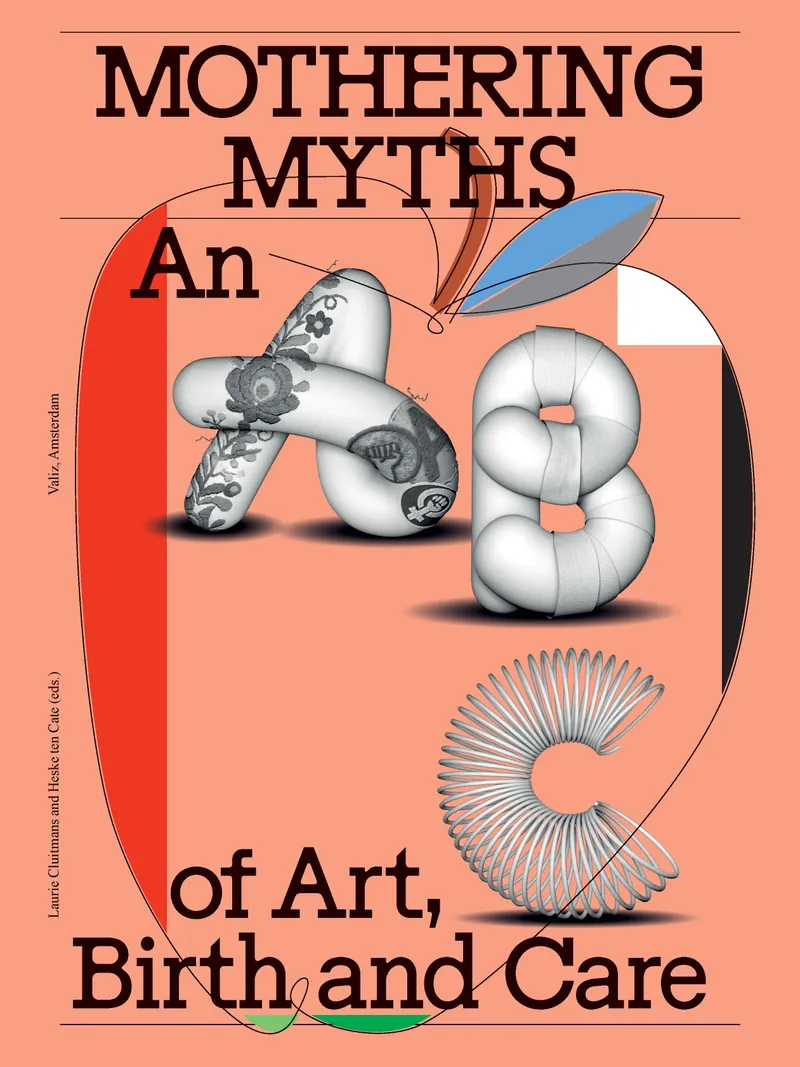
It has taken me longer than twenty years to arrive beyond this equation. Celebrating friends welcoming the newborns in their lives — soft, curious, and precious — I asked myself, whatever happened to birth? On a shelf at Yvon Lambert in Paris, I found Mothering Myths: An ABC of Art, Birth and Care by Laurie Cluitmans and Heske ten Cate. It planted seeds.
Not all making is birthing. Birthing is a fundamental enlivening — the first making of fire, not the burning that follows.
There is a mode of engaging any system — a world, a game, an idea — that is extractive. You enter it, you search the solution space, you deplete the resource. Minecraft works this way. Bitcoin works this way. You take, but nothing new has been made. The world gets smaller with every action. @galaxykate first introduced me to Max Kreminski's gardening as a mode of play, and the principle at its centre: some games are mines. some games are gardens. make gardens, not mines.
Giving birth has been systematically undervalued in our time. Mothering Myths names this directly: the cliché that an artist with a womb must choose between making art and having a child, as if exhausting a finite resource. This is the mining logic applied to the creative body.
There is a recurring suggestion that generative AI represents a kind of birth — that the men who could not gestate are making, at last, something from nothing. The Frankenstein lineage. Birthing without a womb.
Can generative AI be fundamentally birth-giving?
The dominant interface built around it today is a retrieval interface. You prompt, the system returns. The design pressure has consistently been toward making this faster. Reduce the effort between the human and the output. This is the extraction logic imposed on cognition itself. You are not being asked to birth. You are simply being asked to speed-run the retrieval.
A digital system that operates under a defined possibility constraint, however vast, is set at creation — the LLM, at training completion, is a finished map. It navigates with fluency; it surprises locally; but it cannot extend its own boundaries. This doesn't make closed systems inert. Even when they cannot birth within, they can birth outward. An intuitively designed system can generate the conditions under which a leap occurs in the environment where it's encountered — making the edges of one system visible from inside another.
In the physical world, it's the trial and error, the material resistance that misbehaves in your hands. Invention happens at the point of fracture. You try something and it does not work the way the system said it would, and in that failure you can suddenly see that the system interacts with another. That's how you get from inside the frame to outside.
There is a moment anyone who has ever been seized by an idea knows — EUREKA! Two systems collide. An analogy from one mapped onto the logic of another. And in the collision, something appears that was not present in either system individually. A new dimensional space. A thing that could not have been predicted from either starting point. Arthur Koestler called this bisociation — the connection of two habitually incompatible matrices of thought.
The phenomenon is violent in the best sense. It does not feel like regular cognition. It feels like arrival. And in that moment you feel, with total conviction, that you have the right to be here. That you are here to give birth. That your existence is justified by this capacity, which is burning, for the first time, in you.
We must arrive at the right to birth by recognising it as belonging to every human. Every person has the capacity to throw two rocks together to ignite the first fire. There is a particular kind of making — with a womb or without — that expands the space of possibilities rather than limiting it. When you birth, the colouring book evolves. The world after birth is structurally different from the world before. We will have changed what is possible.
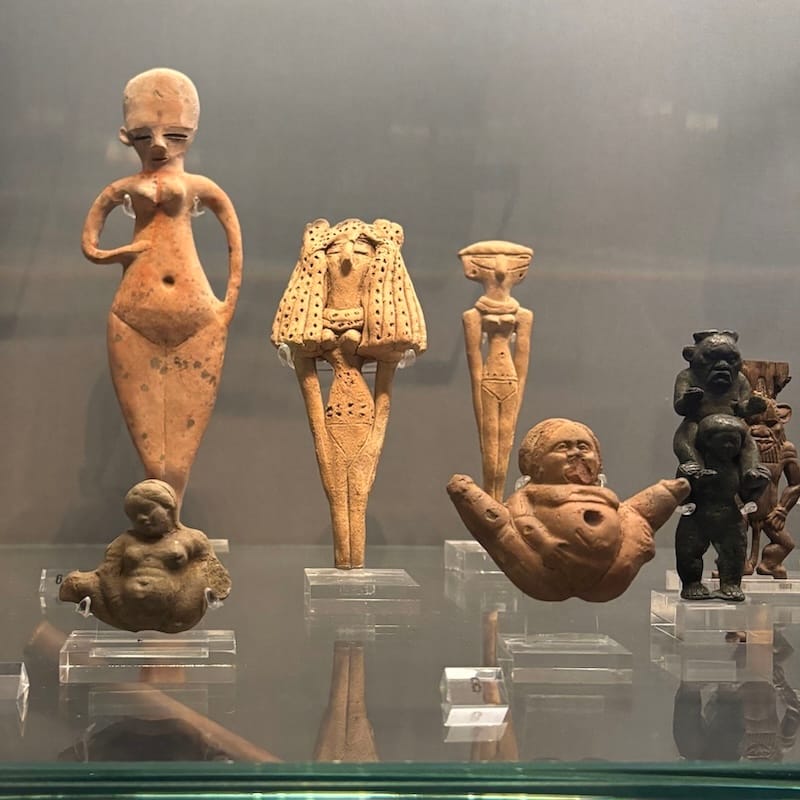
Before you go: a few small objects from the Fitzwilliam Museum in Cambridge. They are very old. They are very small. And they were possibly made by someone who had given birth.
.
.
.
.
.
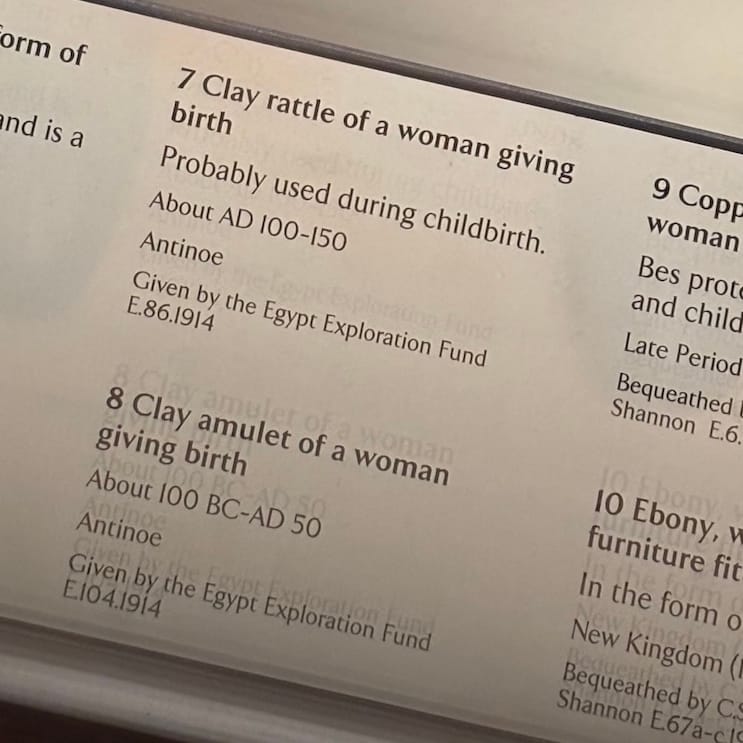
I think about the women who held these in their hands. And thank you, mom, for giving birth.