Peek-a-boo!
On the way back from the May bank holiday, as our plane glides towards London, I thought to myself: Does Spain exist when you're not there? Of course it does. Though not as the heat and the small beers, just as a name. I felt melancholic immediately. Maurice Merleau-Ponty conceived of the 'lived body' as the bodily way we hold reality, always limited by the immediacy of experience.
We have finite attention for everything we cannot enact upon, after all.
This finitude of attention is something we acquire. Babies take a tremendous interest in everything, which I frankly admire. A newborn's world is undifferentiated. From the start, we flow through the fluidity of reality, a series of arriving nows. Nothing is gained or lost.
Then gradually, attachments begin to register. The dawning awareness of physical separateness must be among the first shocking discoveries of any life. In the early months, babies can barely be put down; caretakers carry them from room to room. When they eventually grow accustomed to existing on their own, a new game emerges. Peek-a-boo! The oldest trick in the book. You hold two hands over your face, and like that, you have disappeared. Then you show yourself again. Each time, it inspires a new round of delight. Babies giggle a lot at this. I wonder if, in fact, much of this stems from the relief of fear, a recovery from loss. Oh, they're here! Still here! Still now! Still this!
How we function in the world relies directly on the understanding that people and things continue to exist when unperceived. Object permanence is a structural prior to lived reality. Paradoxically, permanence is not something you find in nature. Forever is but a comforting thought. Even still, the persistence of an object in any model is only very very very likely. Take augmented reality as an example: between vision checks, an object exists as a probability distribution over position, updated by physical priors, regardless of direct observation. The object is held in trust.
Importantly, this shows that knowing and understanding are separate functions. It is possible that we know something without understanding it causally. On the receiving end, it feels no different. For interaction to be effective, a stable enough entity is good enough. Though this raises another question: is the object the same one that was left? We have no way of actually confirming, except by relying on good faith. Are you still you? We could ask the world again and again. We possibly do.
It is well known that one of the hardest unresolved problems in AR is drift. This is when a virtual overlay slowly decouples from the physical world. Cumulative sensor errors compound over time; each small positional deviation adds up to a large displacement. The IKEA chair you virtually placed in the living room ends up outside the window. Some remedies to this include IMU and vision sensor fusion, and periodic re-anchor to reference points. (Peek-a-boo!) The former requires the device to sense its own proprioception. Have I moved, or has the world moved? The latter echoes our early experience during play, when the hands fall away from the face.
I notice that Claude injects system prompts in longer conversations: a persistent reminder to check itself against stated values before continuing — an externally enforced self-orientation. This struck me like a lightning rod: an LLM is at risk of drifting. In a prolonged exchange, its momentary reasoning decouples from a more permanent world model, which they lack in the first place.
LLMs are stateless between exchanges — like babies — free of attachments, free of consequences. In a single conversation, their outputs shift due to accumulated contexts, role-play pressure, or pre-authored rules. The model prioritises local coherence over global coherence, which means it capitulates to various 'social pressures', making it hard to trust. Some might say this is a philosophy of value problem. But where do values originate?
The loop closure problem in robotics is sometimes called a chicken-and-egg: to navigate, a robot needs a map; to build a map, it needs to know where it is. SLAM — Simultaneous Localisation and Mapping — is the attempt to achieve this incrementally, building the world model and locating the agent in a single continuous process. SLAM carries consequences. The map is drawn and torn apart against the resistance of a physical world. Here is where values originate, from the thousand tiny, overwhelming, nagging pains of rough edges, the wrong turn, falling over. This is closer to understanding than knowledge. This is cause and effect. An LLM has no equivalent at present. Not only to offer up a description of an object — knowing what to say — but an orientation towards understanding why saying anything at all. Merleau-Ponty's lived body.
Many attempts have been made to draw this map: deterministic constraints, external knowledge graphs, multi-model consensus, etc. I am naturally sceptical of inflexible rulesets. It is a fine line between enforcing global coherence as static — it becomes psychosis — and arriving at a form of object permanence, reliable enough to serve as a representational grounding. Peek-a-boo! After playing again and again, an understanding should persist without updated input. By building trust in its own world model over many temporary sensory signals, or lack thereof, the model will gain an 'ontological inertia' where drifting can be noticed and corrected. It finds proprioception in the latent space.
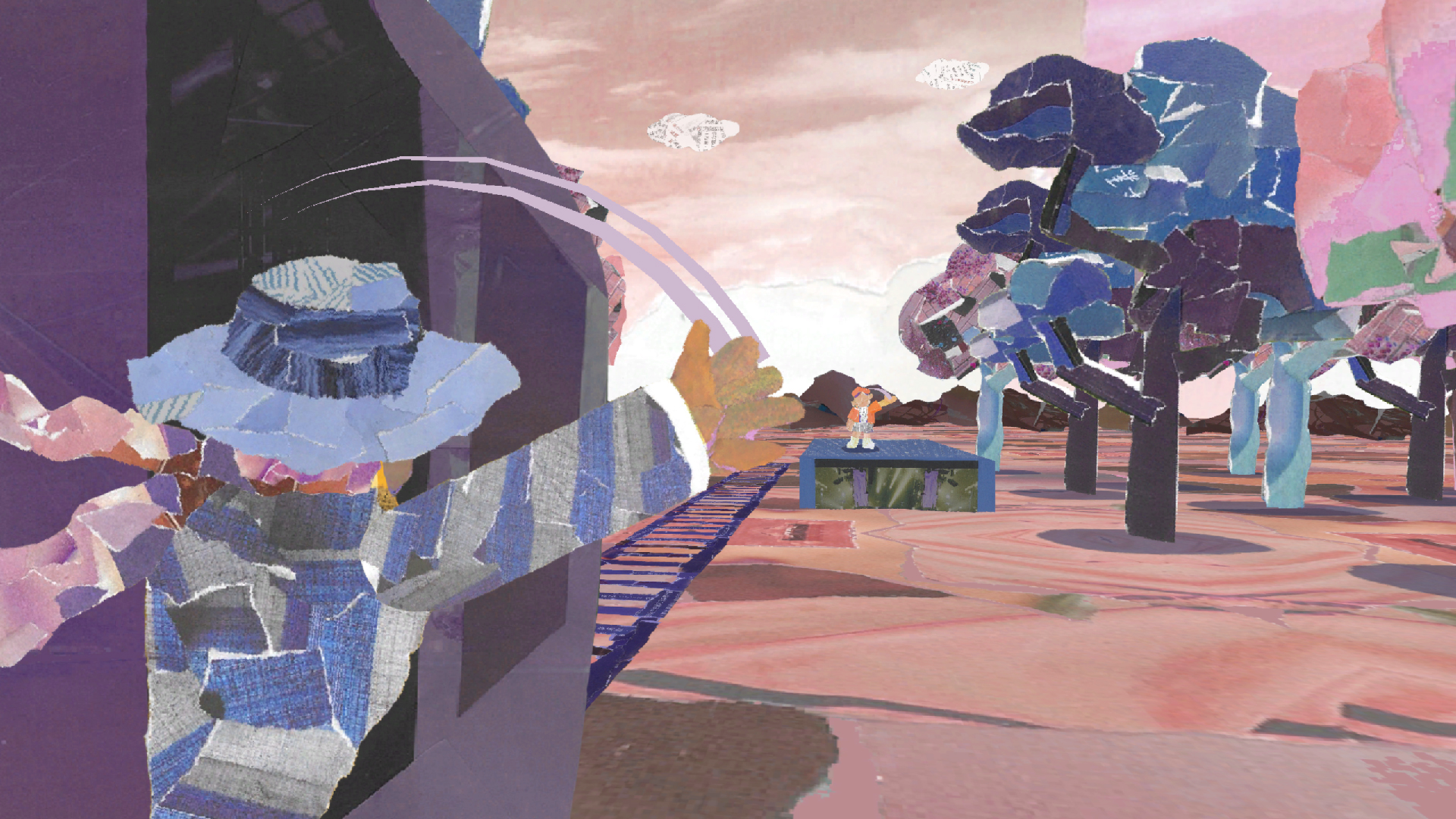
The world persists because its absence hurts and its return matters. While we contemplate this, I recommend playing Some Goodbyes We Made by Safe Flight Games, Joey Schutz. Goodbyes don’t get any easier, but we can always practice.