How to Human in Machine Realities
'Every something is an echo of nothing.' — John Cage
One thing is certain: the world is becoming more complex. Notice the growing interconnectivity between once separate spheres of life — and yet, amidst this abundance, something feels tenuous.
It is an instability not of material deprivation, as it once was, but of an overwrought connection to everything at once. The sheer multiplicity of connections spins us into disorientation. Post-pandemic economies, generative AI, fracturing alliances, the climate crisis — these past few years didn't so much present challenges as stack them. Then collapse. The world today feels like a pile of wooden toys scattered across the playroom floor. And here lies the paradox: we are faced with reordering things, yet we cannot see where any of them fit.
We'd do well to remember that chaos scarcely organises itself into order. Yet, order does emerge organically from chaos — through natural selection, through trial and error, through sustained luck. This is the same fundament for evolutionary algorithms, for theory formulations, for stories that persist over generations. And yet, the compulsion to control reality persists.
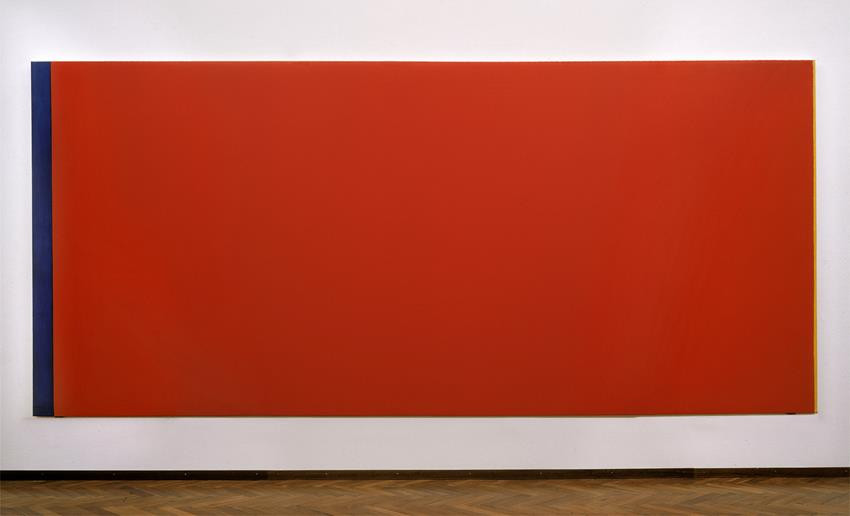
A desire to reason is an expression of the desire to control. We too often confound the accumulation of knowledge with a thorough understanding of the universe. History reminds us that people react violently to what they cannot immediately rationalise. In 1986, a man walked into the Stedelijk Museum in Amsterdam and slashed Barnett Newman's Who's Afraid of Red, Yellow and Blue III with a knife — a vast field of pure colour, nothing more. The attack was not vandalism in the ordinary sense. It was a response to being confronted with something that communicated powerfully through means that logic could not account for. Comprehension had failed, and what rushed in to fill the gap was rage.
Chance is just as difficult to accommodate in the mind. Evelyn Waugh's Brideshead Revisited argues that once we reduce chance to a mathematical formula, we subject it to probability, and probability is certainly rational. In a rational universe, God can work through the infinite instances we call chance. The argument overlooks that chance can be structurally rational and still be irreducibly unpredictable. Probability describes the territory of possible surprises. It does not dissolve the surprise.
The map is rational. The ambush is still an ambush, and the ambush arrives in the body first: the lurch, the catch of breath, the stomach drop before the mind has had time to name.
Miguel Sicart writes about the mutual shaping between humans and software. Software is not a passive tool; it is an active agency with its own internal logic, its own structural pulls toward certain outcomes. Through repeated engagement — playful, adaptive, exploratory — we absorb that logic. Our interior life begins to rhyme with layers of logical systems rather than with the self. We may even find it comforting, the shadows of Newtonian determinism in a clockwork universe.
Then there is the compounded effect of delegating judgment, attention, and desire to external logical agencies over time. This is not a sudden capture. It happens the way all deep changes happen: gradually, then all at once, and mostly without being noticed. Generative AI is only the most recent development, the sediment of everything the English-speaking internet ever produced. This is not an agency looking in from outside — it is the ground we already stand on, the systems we already occupy, operating at scales we cannot hold in mind. A parallel exists in physical reality: the body as ecology; ecology as chemistry; chemistry as physics. Beyond that, the incomprehensible part where systems exceed any single vantage point. To be alive is to be a small system embedded in vastly larger ones, participating in processes you did not choose and cannot fully see. So are your digital footprints in the machine.
The systems, the interconnection, the incomprehensible vastness — these find their distortion through digital means. Digital interfaces operate from the alternative realities of infinite timelines and endless options. We were invited to feast our eyes upon this bottomless brunch: belts were loosened, buttons undone. But human desires were never meant to be boundless, and the appetite the machine cultivates is not quite the same as the hunger we arrived with.
We have come to mistake ease for progress. What machine realities do to friction is perhaps the most consequential. The ambush, the surprise, the unaccountable discovery — digital interfaces are expressly designed to eliminate them. The feed is optimised. The recommendation anticipates. What gets quietly discarded in the process is not merely spontaneity; it is the mode of knowing that arrives before interpretation. The signals were always elsewhere — in the body, in the earth, in the quality of attention available to us once we stopped to look, really look. What dazzles is not always what sustains. And beneath the spectacle, what shapes anything worth having — deep relationships, wisdom, creative fulfilment — is the quiet work of endurance and patience.
We have a body. This is so obvious it is almost never said, and only in recent years taken seriously as a philosophical starting point. If this is what we are — small systems inside vast ones, receiving the world first through the body, embedded in connections we cannot fully map — then the question of how to live becomes less about optimisation and more about localisation. Not how to overperform within the machine realities, but to remain genuinely human inside it.
The body gives confidence because it moves through relational information. It knows where it stands in relation to other bodies, to space, to atmosphere — and it moves with that knowledge before the mind opines. Architecture has long understood this: to be embodied within a built environment is to orient and respond to light, threshold and the resistance of materials. Situatedness is not a limitation; it is what makes experience legible. And once we recover it, something else returns too: the purity of intent in living a physical life. The fun and play, the randomness of occurrences, the joy of discoveries.
In our current state, we neglect an empirical aspect of the universe: it could feel wonderful not knowing. What emerges instead is something like responsiveness. Not control — you cannot control what you cannot know. Not compliance — that would be to flatten yourself against the system rather than move through it. Something more like attunement: being permeable enough to feel what is happening around you, sensitive to the grain of things, able to adjust in the moment rather than only according to plan. The woodworker working with the grain rather than against it. The musician who listens to the room.
This quality of movement — responsive, present, neither rigid nor passive — is play. Not play in the trivial sense, but in the sense that Bernie DeKoven understood it: "The goals, the rules, everything I did in order to create the safety and permission I needed, were so that I could do this – so I could experience this excellence, this shared excellence of the well-played game." — as Eric Zimmerman highlighted from the Foreword to DeKoven's The Well-Played Game. To play well is to be inside the system rather than above it. The rules are real but not crushing. Chance — structurally rational, still unpredictable — is what the game throws at you next, and you are not threatened by it. Physical reality does not resolve into clean categories either — it fluctuates, it holds contradictions, it refuses binary answers. In that state, the distinction between order and chaos stops mattering. Probabilistic thinking, it turns out, was always the more honest position.
The confidence this requires does not come from getting things right. It comes from remaining inside the uncertainty, from showing kindness toward incompetence and mistakes, your own and others'. Build trust, especially in those who are willing to play together. The way we organise around each other matters — and in this era, leadership, like play, is situational. Different moments call for different people forward, not unlike the way children arrange themselves in games: fluidly, without permanent hierarchy, with a lightness about who begins. Celebrate your own achievements. Celebrate someone else's. The new definition of creativity might simply be: do something today, with the people you want to know.
To live well is to move well. To move well is to play well.
This is not a conclusion that logic alone could reach, because it is not a logical proposition. It is something closer to a description of a superstition — one that requires the body as much as the mind, that holds structure, unpredictability, and inconsistencies together without resolving them, and that finds in the incomprehensible vastness of things not a problem to be solved but a fabric to move through, and contribute to.
Machine realities might yet become machines of loving grace. By then, what we call the phenomenon is almost incidental. It could go by any other name. The mystics across traditions kept running into this problem. The Tao that can be named is not the eternal Tao. The finger pointing at the moon is not the moon. At a certain point the most honest response to what is being pointed at is silence, or simply pointing.
Machine realities remain. We could swish around in them. And feel lucky.